


A 14,000-kilometre pilgrimage for the peacebuilders governments won't fund
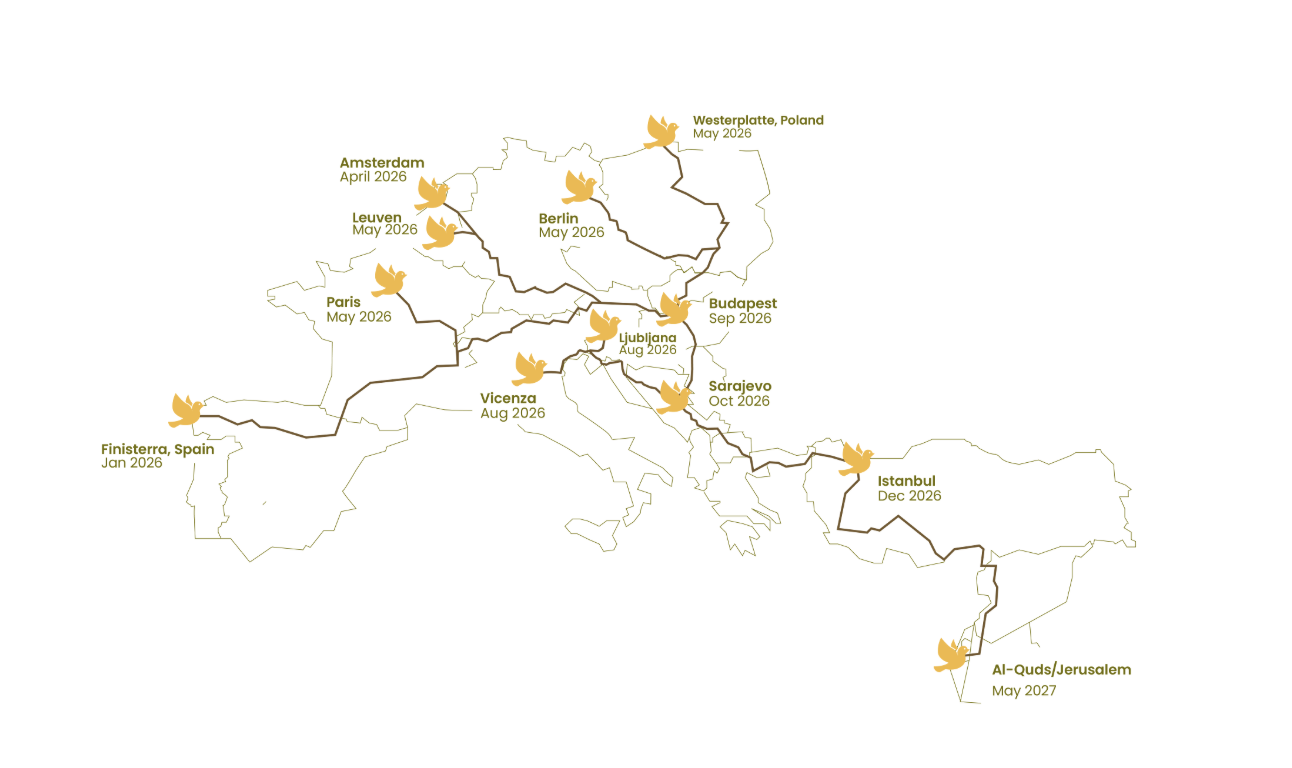
Peacewalk is a collective pilgrimage on foot from Europe to Al-Quds/Jerusalem: 14,000 kilometres, 24 countries, roughly 20 kilometres a day, organised entirely by volunteers rather than any government or institution. The route runs from the Netherlands down through Belgium, France, Spain, Central Europe and the Balkans, into Greece and Turkey, and on through Syria, Jordan, Palestine and Israel, with arrival in Jerusalem planned for May 2027.
Its starting point is a simple conviction: that peace is the responsibility of everyone, not something to wait for from the people in power. Walkers commit to learning from those who built peace before them and those still doing that work today, a commitment the initiative organises around four values it keeps returning to: sacrifice, hope, reconciliation and justice, illustrated through figures from Sophie Scholl and Thich Nhat Hanh to contemporary peacebuilders like Aziz Abu Sarah, Reem Hajajreh and ALLMEP's John Lyndon.
The walk itself works as three things at once. It is a peace school, walking alongside grassroots Israeli and Palestinian peacebuilders, among them Parents Circle and Women Wage Peace, to learn directly from their experience. It is a travelling festival, bringing art, music and cultural encounters to every community along the route. And it is a fundraising campaign, channelling support directly to the people doing peacebuilding work on the ground.
Anyone can join, for an hour, a day, a week or the full fifteen months, no experience required. Along the way, walkers carry no national flags, only the Peacewalk flag or plain white ones, a deliberate choice to make the walk about a shared intention rather than any single country's cause. The people who've joined so far describe it in strikingly personal terms: one walker put it simply, that if someone can't walk their own hope, she will walk it for them.
The manifesto film was built around that same idea. It opens on a single line, "If you don't know what to do, walk!", before laying out the case at the heart of Peacewalk: that governments promise peace while investing in wars, and that it's time to invest instead in the peacebuilders doing the daily, unglamorous work. The film follows their footsteps rather than telling their story for them.
As of the walk's seventh month, Peacewalk had covered roughly 7,500 of its 14,000 kilometres across 8 of 24 countries, with more than 1,500 walkers and 2,000 local supporters having taken part along the way. These numbers move week to week; check peacewalk.info for the current count before publishing.
Initiative: Peacewalk
Learn more, walk, volunteer or donate: peacewalk.info
Team: Robert-Jan Glas, Daan Steinen van Eck, Floor Bresjen, Rikko Voorberg
Manifesto:
Pitch:
Why